Cracking the Code: A Beginner’s Guide to Design Patterns
Vishal Gangapuram
Have you ever started a project feeling confident, only to end up with a messy, confusing code that’s hard to understand, wondering how things got so complicated? Don’t worry, you’re not alone! Every developer — whether they’re just starting out or have years of experience — faces the challenge of writing clean, efficient, and scalable code.
What if I told you that some of the world’s most experienced developers have already faced (and solved!) the very problems you’re struggling with? They’ve packaged their solutions in neat little bundles called design patterns, and they’re here to make your life easier.
But what exactly are design patterns? In a nutshell, they’re like recipes for solving common coding problems. Instead of starting from scratch every time, you can follow a tried-and-tested formula to get things done — without the headaches.
What Are Design Patterns?
Design Patterns are typical solutions to common problems in software design. They represent best practices used by experienced developers to solve recurring challenges in software architecture. Instead of reinventing the wheel each time, developers can refer to these patterns to create efficient, maintainable, and scalable software. Essentially, they provide a way to structure your code so it’s easier to understand, extend, and maintain.
Why Should You Care About Design Patterns?
Imagine you’re building a LEGO castle. Without instructions, you might end up spending hours piecing things together, only to realize that the foundation isn’t strong enough to support the towers. Now, imagine you had a guidebook with detailed instructions on how to build the sturdiest, most flexible castle possible. That’s what design patterns do for your code.
By using design patterns, you can:
Avoid reinventing the wheel: Why solve the same problem over and over again when you can use a solution that’s already proven to work?
Write better code faster: Patterns streamline your development process, saving you time and effort.
Make your code future-proof: Design patterns make it easier to scale and maintain your code as your project grows.
In short, design patterns are your secret weapon for writing clean, maintainable, and scalable code — without having to learn everything the hard way.
When Do You Use Design Patterns?
Think of design patterns as cheat codes for coding. They’re not shortcuts in a bad way — they don’t cut corners. Instead, they’re a way to speed up development while ensuring your code is solid and easy to modify later.
Here are some scenarios where design patterns come in handy:
Recurring problems: If you’re facing the same issue in different projects, chances are there’s a pattern to solve it.
Complex systems: As your app grows, keeping things organized becomes tricky. Patterns help you manage complexity.
Team collaboration: Patterns provide a common language for your team. Everyone knows what a “Factory” or “Observer” does without needing a long explanation.
Types of Design Patterns
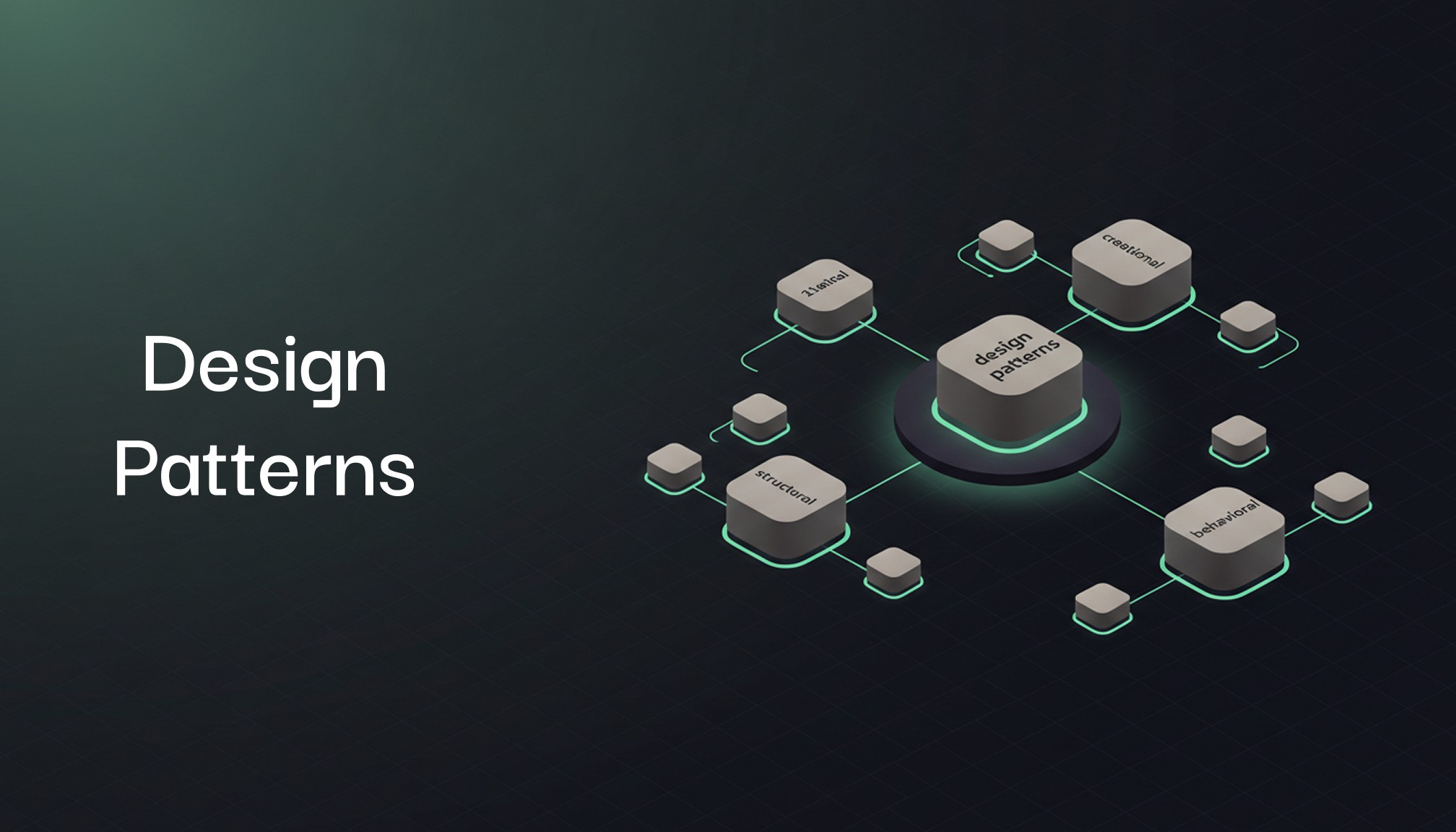
Design Patterns are broadly categorized into three types, each addressing specific areas of software development:
Creational Patterns
These patterns deal with object creation mechanisms, ensuring that objects are created in a manner suited to the situation. They help decouple the system from how its objects are created, composed, and represented.
Singleton: Ensures a class has only one instance and provides a global point of access to it.
Factory Method: Defines an interface for creating objects but allows subclasses to decide which class to instantiate.
Abstract Factory: Provides an interface for creating families of related or dependent objects without specifying their concrete classes.
Builder: Separates the construction of a complex object from its representation, allowing the same construction process to create different representations.
Prototype: Creates new objects by copying an existing object, known as a prototype.
2. Structural Patterns
These patterns deal with object composition or the structure of classes and objects. They help ensure that if one part of a system changes, the entire system doesn’t need to change as well.
Adapter: Allows incompatible interfaces to work together by acting as a bridge between them.
Bridge: Decouples an abstraction from its implementation so that the two can vary independently.
Composite: Composes objects into tree structures to represent part-whole hierarchies, allowing clients to treat individual objects and compositions of objects uniformly.
Decorator: Adds behavior to individual objects dynamically, without affecting the behavior of other objects from the same class.
Facade: Provides a simplified interface to a complex system of classes, libraries, or frameworks.
Flyweight: Reduces the cost of creating and manipulating a large number of similar objects by sharing as much data as possible.
Proxy: Provides a surrogate or placeholder for another object to control access to it.
3. Behavioral Patterns
These patterns are concerned with algorithms and the assignment of responsibilities between objects. They define how objects interact and communicate with one another.
Chain of Responsibility: Allows a request to be passed along a chain of handlers until it is handled.
Command: Encapsulates a request as an object, allowing for parameterization of clients with queues, requests, and operations.
Interpreter: Implements an interpreter for a language grammar or expressions.
Iterator: Provides a way to access elements of an aggregate object sequentially without exposing its underlying representation.
Mediator: Defines an object that encapsulates how a set of objects interact.
Memento: Captures and externalizes an object’s internal state without violating encapsulation, so that the object can be restored to this state later.
Observer: Defines a one-to-many dependency between objects so that when one object changes state, all its dependents are notified and updated automatically.
State: Allows an object to alter its behavior when its internal state changes.
Strategy: Defines a family of algorithms, encapsulates each one, and makes them interchangeable.
Template Method: Defines the skeleton of an algorithm in a method, deferring some steps to subclasses.
Visitor: Represents an operation to be performed on elements of an object structure. It allows one to define a new operation without changing the classes of the elements on which it operates.
What’s Next?
This is just the start of a journey. Over the next few posts, we’ll explore specific design patterns that you can use in your everyday coding life. From solving object creation problems to managing complex relationships between objects, we’ll cover it all — one pattern at a time.
Learning design patterns is like unlocking a superpower for designing robust, scalable, and maintainable software systems. They not only give you a toolkit of time-tested solutions but also equip you with a common language to communicate your design ideas clearly and effectively.
So buckle up and get ready to elevate your coding game! With design patterns in your toolkit, you’ll be coding smarter, not harder. Stay tuned for our next post, where we’ll dive deep into some of the most popular and powerful design patterns that can transform your approach to software development.
Happy coding..!