Cracking the Code: The Proxy Pattern -Gaining Control with Elegance
Vishal Gangapuram
Insoftware development, elegance isn’t just about beautiful syntax; it’s about writing code that’s efficient, scalable, and easy to understand. Enter design patterns, the timeless recipes for crafting robust applications. In this post, part of our “Cracking the Code” series, we’ll dive into the Proxy Design Pattern, one of the most versatile Structural Design Patterns.
If you’ve ever needed to control access to an object, optimize resource usage, or add additional behavior without modifying the underlying class, the Proxy pattern might just become your new best friend.
What is the Proxy Pattern?
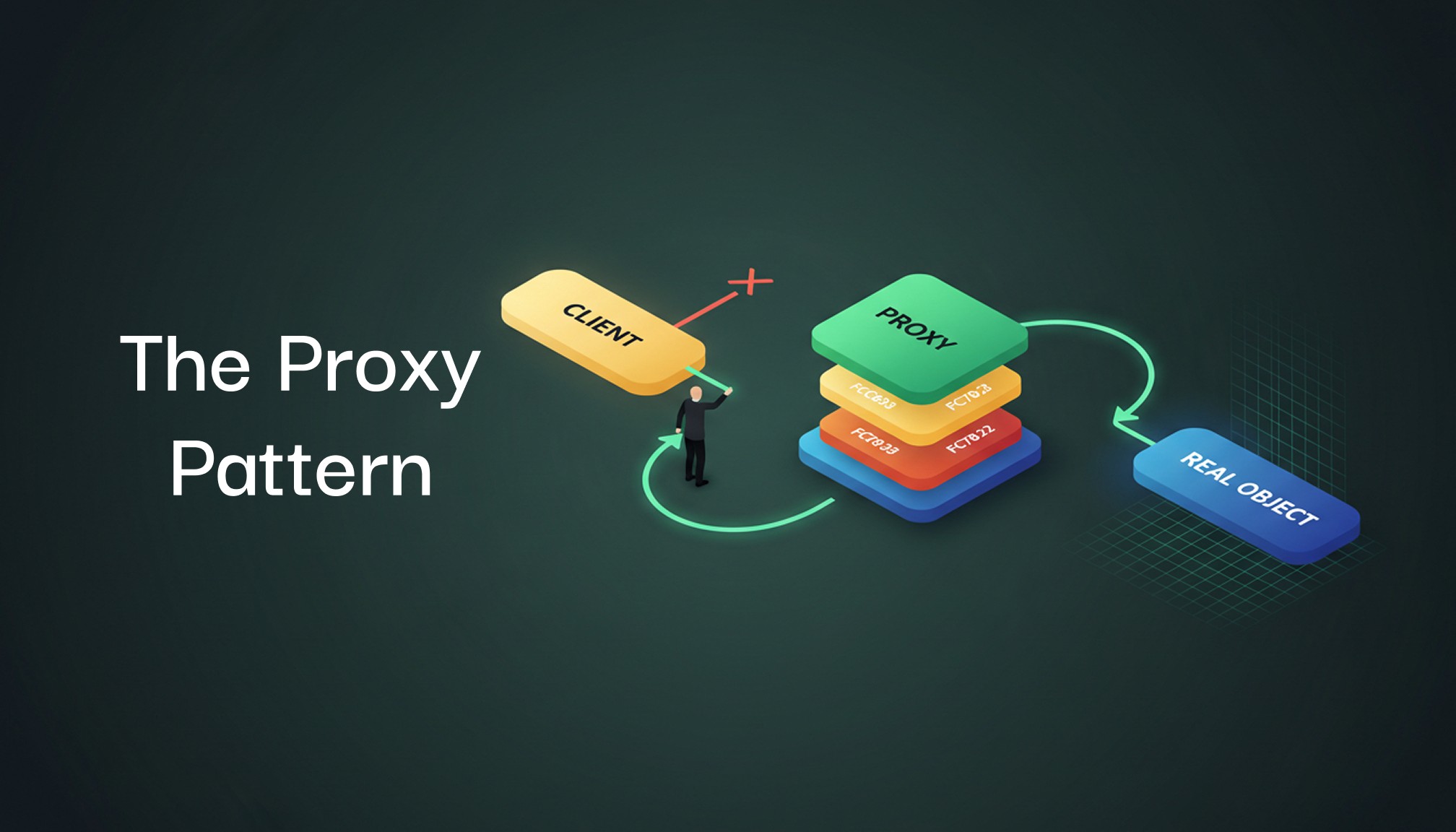
The Proxy Pattern acts as an intermediary, providing a surrogate or placeholder for another object to control access to it. It allows you to perform actions like authentication, lazy initialization, or logging without changing the code of the actual object.
Think of a proxy as a gatekeeper. It controls the entry to a resource, ensuring only authorized or valid requests pass through, and can even optimize how resources are utilized.
How Does It Work?
The Proxy Pattern revolves around three main components:
Subject: The common interface that both the Proxy and the Real Subject implement.
Real Subject: The actual object that the Proxy represents.
Proxy: The intermediary that controls access to the Real Subject.
When a client interacts with the Subject, it doesn’t need to know whether it’s communicating with the Proxy or the Real Subject. The Proxy can introduce additional functionality seamlessly.
When to Use the Proxy Pattern?
Access Control: Restrict access to sensitive data based on permissions.
Lazy Initialization: Load heavy objects only when they are needed, saving memory and processing power.
Logging and Monitoring: Add logging, analytics, or debugging functionality.
Remote Access: Represent objects located in a different address space, such as on a server.
Real-World Analogy
Imagine you’re entering a high-security building. At the entrance, there’s a security guard (the Proxy). You don’t interact directly with the important personnel inside (the Real Subject). Instead, the guard verifies your identity and grants access only if you meet the necessary conditions. This is precisely what the Proxy does in software — it acts as a middleman to control and manage access.
Code Example: Protection Proxy in Action
Here’s how the Proxy Design Pattern can be implemented in C#. This example demonstrates a Protection Proxy that restricts access to sensitive data based on the user’s role.
Breaking Down the Code
IDatabase: Defines the interface for database operations.RealDatabase: Contains the core logic to fetch sensitive data.DatabaseProxy: Implements theIDatabaseinterface and controls access based on user roles.Client: Simulates a user interacting with the database through the Proxy.
Why Developers Should Care
Access Control: You can use a Proxy to enforce role-based access control effortlessly.
Performance Optimization: Lazy initialization can save memory and processing power in resource-intensive applications.
Seamless Integration: Clients interact with the Proxy as if it’s the Real Subject, ensuring a clean and decoupled design.
Advantages of the Proxy Pattern
Simplifies client code by abstracting additional behavior.
Enhances security and monitoring.
Reduces resource usage with lazy initialization.
Adds flexibility by allowing runtime behavior changes.
Potential Pitfalls
Added Complexity: The Proxy introduces an extra layer, which can make debugging and maintenance more challenging.
Performance Overhead: The additional indirection may slightly affect performance.
Conclusion
The Proxy Design Pattern is an elegant solution for scenarios requiring controlled access, logging, or optimization. Whether you’re building a high-performance application or managing sensitive resources, the Proxy pattern can help you strike a balance between functionality and efficiency.
By understanding and applying the Proxy Pattern, you not only gain finer control over your objects but also elevate your code’s architecture to the next level. So, the next time you need a gatekeeper for your resources, remember to reach for the Proxy pattern…